

Quinn Shephard and the Church of Girlhood
Quinn Shephard spent ten years trying to let The Body die. Instead, something in her brought it to market one last time; along the way she discovered the series was something she least expected: funny.
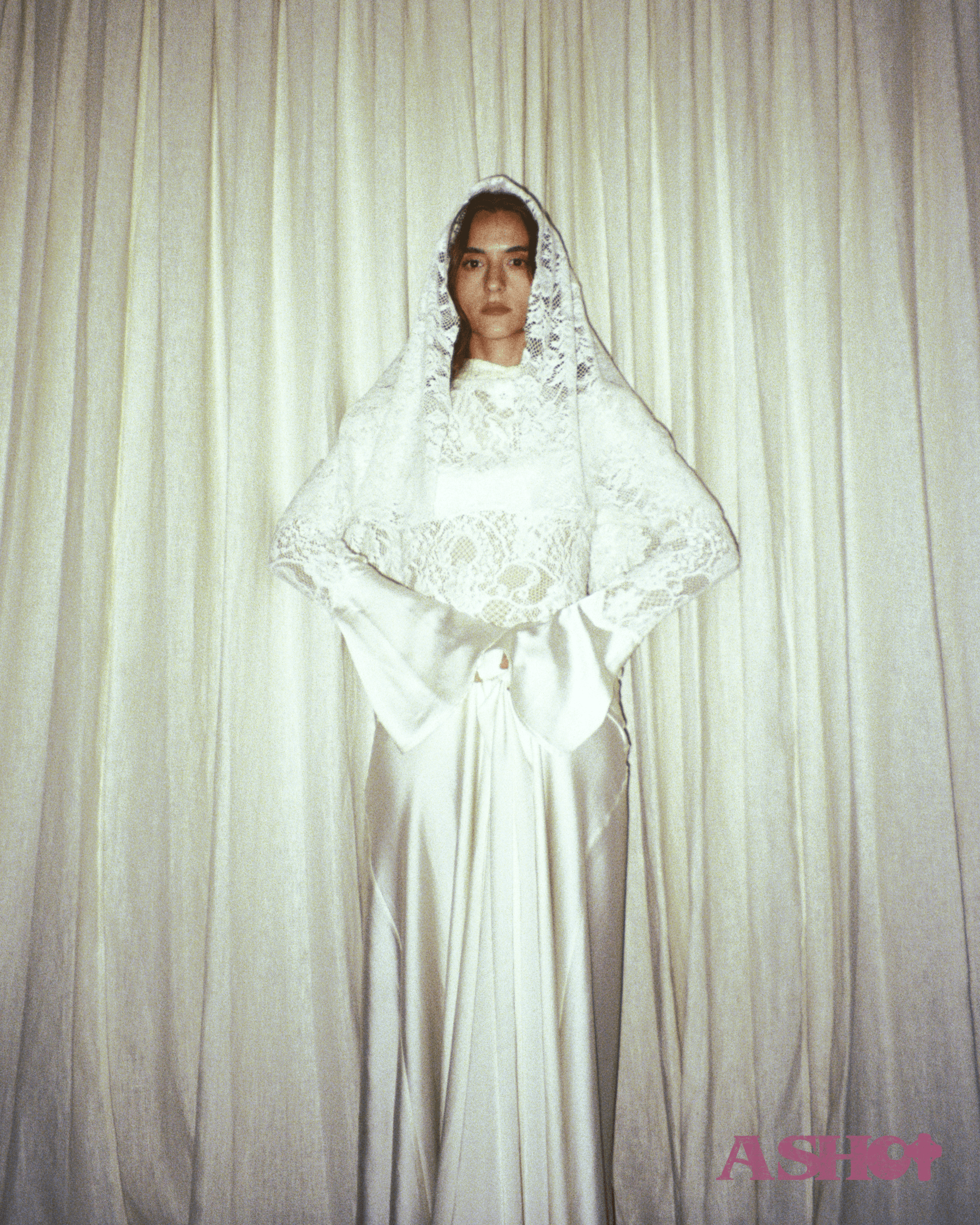
Quinn Shephard spent ten years trying to let The Body die. Instead, something in her brought it to market one last time; along the way she discovered the series was something she least expected: funny. Days before the release of The Body on Netflix we sat down with the show’s creator and co-showrunner Quinn Shephard to discuss casting choices, erotic thrillers, The Crucible, and why the most devout congregation in America might be a group of teenage girls moving in unison.
There is a type of movie you watch at fifteen, alone, on a laptop balanced on your knees, with the volume very low. Quinn Shephard, creator and co-showrunner of Netflix’s current number one series The Body, knows exactly what I mean. Girls peeking around corners, girls looking through doorways, and even a fight in a swimming pool that turns into something… else. “That genre,” she says of the erotic thrillers she was obsessed with growing up, “was a lot of the first representation I had seen in media of women being obsessed with other women.”
The Body is in some sense a return to that laptop. It is soapy and playful, full of fan theories and backstories and dynamics that people have started texting her about at all hours. But the playfulness is her delivery system for more personal themes. “The show is soapy and playful as a means of getting at some quite personal and political and human thoughts,” she tells me.
“I hope that people see the meaning within the playfulness.”
dress @marinaleightatelier photographer xinger xanger (@xingerxanger)
dress @marinaleightatelier
We speak a week prior to the premiere, at a time when Shephard has admittedly clocked the internet becoming aware of her show. “It’s kinda nuts,” she says. “I’ve wanted to make this show for almost 10 years. Seeing people in the real world having any sort of knowledge of it is so surreal.”
Ten years is not an exaggeration. Shephard sold The Body to FX in her early twenties. It was developed there, and then it wasn’t. She took it to other studios as well. Netflix almost bought it the first time, and one of the executives in that room, Emma Miller, is now on the team that brought it home (thank you, Emma, we all say in unison).
In between came Under the Bridge, and the question every agent asks after a show lands: what’s next? Shephard didn’t have a good answer, because the only answer was the one she’d been carrying for a decade. “There was a part of me that was always trying to make The Body,” she says.
“Since it died, I couldn’t let it go.”
What changed this time around wasn’t the show itself, but rather her own experience with the material on the page. She returned to the original pilot with her co-showrunner and producing partner, Gina Gammell, and the material that had felt so heavy in her twenties suddenly played differently out loud. “We were reading and laughing and laughing, laughing with the characters,” she says. “We were like, oh, it’s camp. It’s playful. It wants to be fun.” She had promised herself she was done with dead-girl stories, done with anything overly serious. The new version leaned into irony and self-reference, and into mass hysteria, which had been a more classic thriller the first time around. And is still kind of a dead-girl story.
dress @marinaleightatelier photographer xinger xanger (@xingerxanger)
dress @marinaleightatelier
Shephard took it out with North Road and Felix Culpa, Riley Keough’s film banner, armed with a full outline of season one, a sizzle reel, a deck and a pilot. It was this version or nothing. “It would actually kill my soul to go in and start pulling it apart,” she says. Netflix bought it in the room, which had never happened to her before, and greenlit the first season as part of the same deal. After a decade of waiting, the rest happened fast.
The camp most people recognize is maximalist: excess, glitter, etc. The version Shephard describes is quieter and sadder, a kind of tragic camp. It’s the camp of intensity that hasn’t found a place of belonging: the over-serious crush, the friendship that feels like a vow, the yearning that would look ridiculous if it weren’t so sincere. It’s funny because the stakes are enormous and invisible at the same time. Hence “tragic.”
That’s why the erotic-thriller tropes work in her hands rather than reading as pastiche. Peeking around corners and spying through doorways are the grammar of a love that has to hide. The pool fight, the kiss in the water: the old genre staged these for a presumed outside viewer. Shephard re-stages them for the girls themselves. “What is that with a grounded lens?” she asks. “What is that when we understand all of the thought processes going into it for all of these characters?” The tropes stay, but the gaze moves. The internet, predictably, has already chosen its favorite pairing in Anya and Elise. As a child of the Carol GIFs and Brittany and Santana shipping, I understand why.
dress @marinaleightatelier
If the erotic thriller is one root of The Body, the other is older and stranger. At fifteen, Shephard did a local production of The Crucible and, by her own account, made it her whole personality. Arthur Miller’s witch trials echo through Blame, her first film, and they echo again here.
It’s not hard to see why. The Crucible is, at its core, a story about adolescent girls in a religious community whose private feelings become a public catastrophe, where hysteria spreads through a group and gets read as possession. Put a teenage girl who is beginning to understand her own desire inside that play, and the metaphor becomes clear.
Shephard draws the line herself. One side of her family was very religious; the other was raised Catholic and stopped practicing. She was deeply involved in religion as a small child, then raised without much of it as a teenager, at a time when there was little language for faith that made room for queerness. Religion, she says, “became very symbolic of a lot of shame and confusion for me.” She read Carrie. She read Equus. She gravitated toward stories about spiritual experiences that were weird, shunned or shameful, and only as an adult understood why. “These characters were struggling with feeling drawn to this experience of passion, enlightenment, ecstasy,” she says, “and then feeling all this shame about it. At the time, I didn’t know what that was for me.”
Passion, enlightenment, ecstasy. These are words from mysticism, and they are also, word for word, words for desire. Western religious art has always known this. The saints’ raptures were painted to look a lot like something else. Shephard’s insight is that for a closeted teenager, the two experiences can be truly indistinguishable. The pull toward God and the pull toward the girl in the next pew arrive in the same body, with the same intensity, followed by the same shame. The Body doesn’t treat religion as the enemy of queer desire, or as a stand-in for it. It treats them as two names for a similar overwhelming feeling.
dress @marinaleightatelier photographer xinger xanger (@xingerxanger)
dress @marinaleightatelier
What surprised me is that making the show has made Shephard more sympathetic to faith, not less. She has always been spiritual, but she now understands, in a way she wasn’t ready to as a teenager, why people need organized religion, even as she keeps examining the power structures and judgment around it. “The human desire to have faith, to have a spiritual experience, a religious experience, is one of the most fundamental facets of human nature,” she says. “It’s like the desire to be loved. We all have it. Whether you’re like, ‘Oh, I’m an atheist, but I take a lot of mushrooms and I see God,’ everyone’s searching for their own version.”
The easy version of this show would be a takedown: repressive elders, hypocritical church, girls breaking free. Shephard’s version holds two things at once. The Bible references in the series are sometimes reverent and sometimes the girls openly poking fun at their elders, and they came from a writers’ room with people from many religious backgrounds, from someone who studied Catholicism to someone raised in it. “There’s some really good lore that you can use,” she says. Lore is the right word: material you can respect and play with at the same time.
It’s also a belief system that works on you even if you don’t hold it. I admit to her that, as a sometimes-believer who went to Catholic school, some of the show’s satanic moments still made me flinch. She asks whether I’d touch a Ouija board. I say I would, with hesitation. “I would not,” she says. She has had a few experiences with spirits, the kind that could be explained by science or by not science, and grew up in a house with one very haunted part. “We all just kind of know,” she says, “and we’re like, don’t talk about it.” Which is also a pretty accurate description of growing up queer in a religious family.
dress @liabayasir
I have been impatiently waiting to get into the show’s undeniable fairy dust: how this cast, and their chemistry, came to be. These are unknown actors who, just a few episodes in, make it clear they will not be unknown for much longer.
When I ask Shephard who was cast first, she has to stop and think. “I’m genuinely trying to remember,” she says.
Shephard does keep a list and always has, “running tabs on actors who were interesting to me, up and coming,” and her mother regularly sends her names from indie films: “You gotta keep your eye on this girl I saw in this indie film.” But almost none of The Body’s cast came from that list. Most of them came in on tape, people Shephard had never heard of, through the casting director Jennifer Venditti, whom she calls a genius. “It was really a discovery process,” she says.
Casting from tapes means the audience meets these girls the way the girls meet each other: with no backstory except what’s on screen. It also makes it that much more special when a character walks in and everyone thinks, here they are!
top @marinaleightatelier
That’s almost exactly what happened with Sara Boustany. She was one of the first to join, after initially taping for a different role. “She sent in a tape for Anya, actually,” Shephard says, “and I was like, that’s Elise. From the first 10 seconds of her tape, I knew she was gonna be Elise.” Even Venditti, who has spent a career finding faces no one else has, was struck. “Where has she been? Who is this?” Shephard remembers her saying.
Geena Meszaros, who plays Lisbeth, was discovered last. After a months-long worldwide search, with the team close to having to stop casting altogether, a tape arrived from Calgary, Canada, from an actress who hadn’t been submitted in any of the earlier rounds. “She was the last person who ever taped for the role,” Shephard says. What set her apart was a swing at the character no one else had taken. Lisbeth is the show’s most unsettling figure, and most actresses played her that way. Meszaros played her funny. “Her sense of humor is just very specific to her,” Shephard says. “She’d really gone for it with the humor in a way that no one else had taken that swing, and it delighted us.” They met her and, in Shephard’s words, “were immediately like, well, found her. That was always Lisbeth.”
Lisbeth’s comedic sensibility is one of the show’s sneaky and beautiful qualities that surprise and delight you at every turn. It also provides the perfect amount of reprieve right when things are getting that extra bit weird. It’s the dry, tragic camp Shephard describes elsewhere, built into a single performance: someone whose humor and menace come from the same place. (A footnote that suits a show built around a dance team: Meszaros was also a competitive dancer when she was younger, and Shephard says there’s a video of her doing a little salsa dance with a fan that she hopes makes it online soon. We do as well.)
Then there’s Kristina Bogic, who plays Anya—the show’s lead and, simply put, a star. She was 18 when she was cast, living in Australia, and had never done an American accent. What sealed it was the chemistry read with Boustany. “She and Sara just had this beautiful chemistry when they ran together, and that cinched it, for sure,” Shephard says. She lingers on Bogic’s energy: “She’s so magnetic. There’s such a warmth and openness in Kristina’s energy that is so special, so rare to find.” Warmth and openness are exactly what The Body needs at its center—someone the camera, and the other girls, can’t stop looking at. It’s no accident that Anya and Elise are already the duo the internet won’t let go of.
top @marinaleightatelier
The chemistry didn’t end with the audition. The cast spent about a month in dance rehearsals with Ryan Heffington before filming started, training, bonding and learning to move together. By the time cameras rolled, Shephard says, they were a real dance team. Some of what reads as fairy dust on screen is a month of these girls actually becoming a group.
Not every audition and casting idea arrived on tape. Coach Miller started as a joke in the writers’ room. Everyone kept asking, “Who is Coach Miller? We’re trying to understand Coach Miller,” and Shephard told them to just picture Gabby Windey from The Traitors. “And then we were like, wait, why shouldn’t it just be Gabby?” A muse in the room became a member of the cast. The Gabby Windey arc, from the Bachelor franchise to The Traitors to The Body, is something I and many others should be grateful for, and not at all surprised by.
Throughout our conversation I was surprised to learn that Shephard is not a dancer. Her mother, a ballet dancer, diagnosed the problem early: feet too flat, temperament too dramatic and sensitive, and a fatal intolerance for the feeling of tights. “She’s like, ‘That’s not a ballerina,’” Shephard says. But the dance team is the show’s central image, and its thesis.
“The show is so much about girlhood and femininity as a religion,” she says.
“There is nothing more the pinnacle of that than a girls’ dance team. Everyone moving in synchronicity, everyone part of this body.”
top @marinaleightatelier photographer xinger xanger (@xingerxanger)
top @marinaleightatelier
A dance team has everything a church has. It has a liturgy: the routine, repeated until it’s in your muscles. It has vestments: the uniform, the identical hair, the makeup applied the same way on every face. It has a clergy in the coach, a calendar of feasts in competition season, rules about the body and punishment for breaking them. Above all, it promises what religion promises: that you can disappear into something larger than yourself. In Christian theology, the faithful become the body of Christ, many members and one body. On a dance team, a dozen girls become one shape, and the highest compliment is that no one stands out.
That is the beauty of it and the horror. The same mechanism that produces transcendence produces groupthink, and Shephard is interested in both. “Both visually and emotionally, with all of the exploration of groupthink,” she says, the dance team let her stage the show’s mass hysteria in the frame itself. A line of girls hitting the same count is a kind of rapture. It’s also a kind of surveillance: everyone watching everyone, and any girl a half-beat off is instantly visible. Femininity as a religion means femininity with dogma, rituals of belonging and the fear of being cast out. Seen that way, the move from “dead girl” to “mass hysteria” was really a move from one victim to a whole congregation.
How she built that team says a lot about what she values. The cast did all their own dancing, with no doubles. The girls were at different levels, and rather than hiding that, Heffington built routines around each dancer’s skill, while the more advanced dancers helped the others catch up. It’s a production choice that mirrors the show’s argument. A body double would have broken the illusion; real girls learning to move as one is the illusion. The unevenness helps too. Every real high school team has three girls who are just slightly better than everyone else, and the camera knows it—I also knew it, which is why I didn’t join the dance team; I would hate others to feel jealous of my top tier skills.
dress @liabayasir
Many of the actresses insisted during callbacks that they weren’t dancers, then sent videos with a leg over their head. “Well, I’m not professional, so I’m not gonna call myself a dancer,” Shephard remembers them saying. It’s a very girlhood kind of modesty, the rule that you can’t claim a skill until someone gives you permission, and in a show about the unwritten rules of femininity, it’s hard not to read it as part of the text.
Of course, with a show this morally confused, I had to ask Shephard who she’d trust in real life, and the answers are their own beautiful little character study. Katie and Claire she would trust with her life. Father Franklin, “a good man with a good heart,” who would also be bound by confession. Lisbeth, too, but on her own terms: “I would trust that she would manipulate someone into doing something advantageous for me.” The one she wouldn’t trust is Lisbeth’s father, with his signs-following videos. If you’ve seen the show, it’s not hard to see why, and even the thought of the video made me semi-uncomfortable if we’re being honest.
Every A Shot conversation ends with the same question: if you were a shot in a film, which would you be? Shephard picks a scene from Joachim Trier’s Thelma: a girl, high and fantasizing about the girl she has a crush on, as the world falls away into a black abyss and a snake crawls in through her mouth and down her throat. “Very sensory, very evocative,” she says. Watching it the first time, she remembers thinking that someone had crawled into her soul.
“That was the most seen I had ever felt by a film.”
That’s Shephard’s whole show in one image, or at least its soul. The snake is the oldest symbol of temptation in the Western canon, and Trier puts it inside a girl at the exact moment of her desire. Is it sin or ecstasy, punishment or release? The image refuses to decide, and so does The Body. It also looked, she adds, exactly like her mood boards at fifteen.
top @marinaleightatelier photographer xinger xanger (@xingerxanger)
dress @liabayasir
The soundtrack tells the same story. While writing, she listened to Marika Hackman’s cover of “I Follow Rivers” on repeat. Hackman later collaborated on the score, a full-circle moment she clearly still can’t quite believe. She also listened to boys’ choirs singing in Latin, and later dove into 2004, the year the show is set: Frou Frou and the memory of sweaty school gyms. Sacred music and a middle school dance: on paper, opposites. In Shephard’s world, they’re the same ritual: a room full of young people, a shared rhythm, a feeling too big for the body it’s in, and adults watching from the edges, pretending not to see.
She says that finishing the show has left her mind a little blank about what comes next. “It’ll be like, what’s the next fixation?” she says. If the last one is any guide, I will gladly wait another ten years.
- Photographer: Xinger Xanger @xingerxanger
- Art Department: Hallie Gluk @halliegluk
- Assistant: Alex Punch @alexpunch1
- Makeup: Pablo Macias @pablomaciasr
- Hair: Jay Birmingham @jaybirmingham_
- Stylist: Jaiin Kang @jaiinkang
- Stylist: Rachel Thorson @rachelthorson